Two helpful tools with comparable features, the one for free, the other shareware:
L-lingo
ThaiTrainer111
Enjoy it!
Showing posts with label Phasa Thai. Show all posts
Showing posts with label Phasa Thai. Show all posts
Tuesday, 17 November 2009

Saturday, 8 August 2009
ภาษาศาสตร์ภาษาไทย (Thai Linguistics) by เรืองเดช ปันเขื่อนขัติย์ (Ruengdet Pankhuenkhat)
A new, interesting book is ภาษาศาสตร์ภาษาไทย (Thai Linguistics) by เรืองเดช ปันเขื่อนขัติย์ (Ruengdet Pankhuenkhat):


An interesting feature is the usage of English terms for defining Thai lingustic terms.


An interesting feature is the usage of English terms for defining Thai lingustic terms.
Wednesday, 20 May 2009
Teaching Thai to Foreigners
According to my best knowledge the publication Teaching Thai to Foreigners has been issued by the RI. Unfortunately a) I do not know how to find it at RI (link), and b) have no English translation available. I would be interested in both.
The Tai-Kadai Languages

The Tai-Kadai Languages
Von Anthony Diller, Jerold A. Edmondson, Yongxian Luo
Edition: abridged
published by Routledge, 2008
ISBN 070071457X, 9780700714575
683 pages
GoogleBook
Wednesday, 22 April 2009
Sunday, 30 November 2008
Friday, 17 October 2008

Saturday, 6 September 2008
Friday, 15 August 2008
Resources on Thai word origin and usage
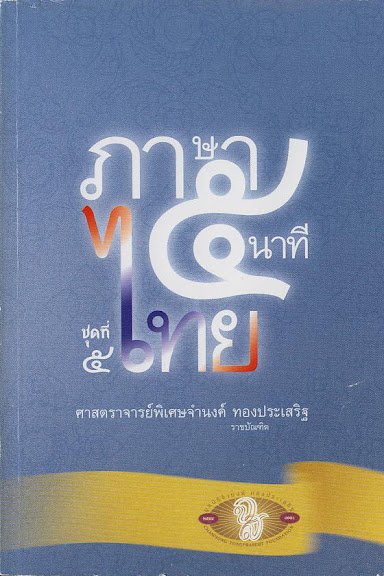
The title means '5 Minutes of Thai Language'. This series is up to volume 9 now. I own 3 and 5, I believe. They consist of transcripts from Prof. Chamnong's long-running five-minute radio show of the same name. I'm not sure if it's still on the air, but I don't think so.
A fellow of the Royal Institute who has held pretty much every position of leadership in that organization over the years. The good professor is in his seventies, but still active at the Royal Institute, as far as I know. I interviewed him for my senior thesis back in 2005.
About 150 transcripts are freely available on Prof. Chamnong's website (note: that link goes to page 1 of 3, so be sure not to miss the full set of available articles). I believe this represents the full contents of vol. 3, possibly more.
Sunday, 13 July 2008
Thursday, 10 July 2008
อักษรไทยปัจจุบัน
หลักภาษาไทย (Principles of the Thai Language) by กำชัย-ทองหล่อ, ISBN 974-246-635-1
อักษรไทยปัจจุบัน
[อักสอน ไท ปัดจุบัน]
akson Thai patchuban
Das Thaischriftsytem der Gegenwart
อักษรไทยปัจจุบันแบ่งออกเป็น ๔ ชนิด :- สระ พยัญชนะ วรรณยุกต์ และ เลข
[อักสอน ไท ปัดจุบัน แบ่ง ออก เป็น ๔ ชะนิด :- สะหฺระ พะยันชะนะ วันนะยุก และ เลข]
akson Thai patchuban baeng ok pen 4 chanit:- sara, phayanchana, wannayuk lae lek
Das Thaischriftsystem von heute besteht aus 4 Elementen: Vokale, Konsonanten, Tonzeichen und Ziffern.
สระ มี ๓๒ ตัว คือ :-
[สะหฺระ มี ๓๒ ตัว คือ :-]
Sara mi 32 tua khue
Es gibt 32 Vokale, dies sind:
อะ อา อิ อี อึ อื อุ อู เอะ เอ
a a i i ue ue u u e e
แอะ แอ โอะ โอ เอาะ ออ เออะ เออ เอียะ เอีย
ae ae o o o o oe oe ia ia
เอีอะ เอีอ อัวะ อัว ฤ ฤๅ ฦ ฦๅ อำ ใอ ไอ เอา
uea uea ua ua rue rue lue lue am ai ai ao
ตามธรรมดาสระในภาษาไทย นอกจาก ฤ ฤๅ ฦ ฦๅ แล้ว จะเขียนตามลำพังไม่ได้
[ตามทำมะดา สะหฺระ ไน พาสา ไท นอกจาก ฤ ฤๅ ฦ ฦๅ แล้ว จะเขียนตามลำพังไม่ได้]
tamthammada sara nai phasa Thai nokchak rue rue lue lue laeo cha rian tamlamphang mai dai
Gewöhnliche Vokale, davon ausgenommen sind rue, rue, lue und lue, können nicht alleinstehend geschrieben werden.
จะต้องมีตัว „อ“ กำกับอยู่ด้วยเสมอ เพื่อเป็นเครื่องหมายให้รู้ว่าเป็นสระลอย
[จะต้องมีตัว „อ“ กำกับ หฺยู่ด้วย สะเหฺมอ เพื่อ เป็น เคฺรื่อง หฺมาย ไห้ รู้ ว่า เป็น สะหฺระ ลอย]
Cha tong mi tua o ang kamkap yuduai samoe phuea pen khriang mai hai ru wa pen sara loi
[Sie] müssen immer zusammen mit dem Zeichen „อ“ stehen, um ein Symbol zur ergeben, das auch als „frei stehender Vokal“ (sara loi, frei flottierender Vokal) bekannt ist.
Table 1 below shows finally the tone rules in form of a matrix.
Table 1 Matrix for the determination of the tone pitch taking into account also the Thai terms (numbers) for the intonation
Class of the initial consonant (A) | Quality of the syllable (B) | Tone mark (C) | |||||
| „live“ คำเป็น | „dead“ คำตาย | ่ | ้ | ๊ | ๋ | |
|
| long…short | |||||
M (อักษรกลาง) | 0 | 1 | 1 | 2 | 3 | 4 | |
H (อักษรสูง) | 4 | 1 | 1 | 2 |
| ||
L (อักษรต่ำ) | 0 | 2 | 3 | 2 | 3 | ||
Note: presence of a tone mark breaks quality of the syllable | |||||||
M, H, L: Middle, High, and Low initial consonants (อักษรกลาง - อักษรสูง - อักษรต่ำ)
0 เสียงสามัญ (siang saman/even tone) mid (neutral) intonation
1 เสียง เอก (siang ek/first tone) low intonation
2 เสียง โท (siang tho/second tone) falling intonation
3 เสียง ตรี (siang tri/third tone) high intonation
4 เสียง จัตวา (siang chattawa/fourths tone) rising intonation
Names of the tone markers:
่ ไม้ เอก mai ek 1st marker
้ ไม้ โท mai tho 2nd marker
๊ ไม้ ตรี mai tri 3rd marker
๋ ไม้ จัตวา mai chattawa 4th marker
Figure 1: A graphical display of the 5 intonations of Thai language

Sunday, 9 March 2008
How to apply the Cologne Digital Sanskrit Lexicon on RID?
 ท่า-อา-กาด-ยาน-สุ-วัน-นะ-พูม
Thaakatyan Suwannaphum
According to UNO (UNGEGN), geographical names of/in Thailand should be romanized by applying RTGS (Royal Thai General System).
This general and even international rule has, obviously, not been applied on the "road" sign above for two reasons.
1. One of several rules displayed in footnotes of RTGS reads:
"Geographical names proper nouns are not translated; general transcription rules are applied instead. For example, เขาสอยดาว = Khao Soi Dao (not Soi Dao Hill), แม่นํ้าป่าสัก = Maenam Pa Sak (not Pa Sak River), ถนนท่าพระ = Thanon Tha Phra (not Tha Phra Road), เกาะสีชัง = Ko Si Chang (not Si Chang Island)."
Thus, an issue is why on a Thai "road" sign the term ท่าอากาศยาน has been "romanized" to airport, the latter being obviously not the "proper noun" for the biggest airport of Rome, i.e. "Aeroporto Leonardo da Vinci di Fiumicino".
2. The term ("Aeroporto") Suvarnabhumi is neither the romanization of the/a Thai term nor a transliteration of the Pali-Term (สุวรรณภูมิ is in Thai a Pali-loanword). It is, as simple as surprising, the transliteration of a Sanskrit term. Why such a strong statement?
A look in RID helps considerably to clarify the issue:
สุวรรณ, สุวรรณ– [–วัน, –วันนะ–] น. ทอง. (ส. สุวรฺณ; ป. สุวณฺณ).
ภูมิ ๑, ภูมิ– [พูม, พูมิ–, พูมมิ–] น. แผ่นดิน, ที่ดิน.
First, it becomes clear that the Thai term reads in TPA/สัทอักษรไทย สุ-วัน-นะ-พูม.
Second, the direct transliteration of the Pali Term สุวณฺณ results, written in IAST (the IAST [International Alphabet for Sanskrit Transliteration] values for Thai-letters can be found e.g. in Wikipedia), in suwaṇṇa while the Sanskrit term actually results in suwarṇa, as seen on the road sign above.
But, what to do with coming to the conclusion that Suvarnabhumi is neither the romanized Thai term nor the Pali term transliterated to Latin letters?
We can have a look into an online Sanskrit dictionary such as the Cologne Digital Sanskrit Lexicon.
This lexicon, however, does not use IAST but the Harvard-Kyoto (HK) convention.
สุวรฺณภูมิ is, according to HK convention, suvarNaBhUmi. With this term we can now search in a Sanskrit Lexicon:
2 suvarNa mf(%{A})n. of a good or beautiful colour , brilliant in hue , bright , golden , yellow RV. &c. &c. ; gold , made of gold TBr. ChUp. R. ; of a good tribe or caste MBh. xiii , 2607 ; m. a good colour MW. ; a good tribe or class ib. ; a kind of bdellium L. ; the thorn-apple L. ; a kind of metre VarBr2S. Sch. ; m. N. of a Deva-gandharva MBh. ; of an ascetic ib. ; of a minister of Das3a-ratha R. ; of a son of Antari1ksha , Vp. ; of a king of Ka1s3mi1ra Ra1jat. ; of a poet Cat. ; m. (rarely n.) a partic. weight of gold (= 1 Karsha , = 16 Ma1shas , = 80 Raktika1s , = about 175 grains troy) Mn. MBh. &c. ; a gold coin Mr2icch. ; a kind of bulbous plant (= %{suvarNA7lu}) L. ; a kind of aloe L. ; a kind of sacrifice L. ; (%{A}) f. turmeric L. ; Sida Rhomboidea or Cordifolia L. ; another plant (= %{svarNakSIrI}) L. ; a bitter gourd , colocynth W. ; N. of one of the seven tongues of fire MW. ; of a daughter of Ikshva1ku (the wife of Su-hotra) MBh. ; (%{I}) f. the plant Salvinia Cucullata (perhaps w.r. for %{sukarNI}). L. ; (%{am}) n. gold (of which 57 synonyms are given) AV. &c. &c. ; money , wealth , property , riches L. ; a sort of yellow sandal-wood L. ; the flower of Mesua Roxburghii ; a kind of vegetable (= %{gaura-suvarNa}) L. ; red ochre (= %{suvarNagairika}) L. ; the right pronunciation of sounds S3Br. ; N. of a Ti1rtha MBh. ; of a partic. world ib.
1 bhUmi f. (Ved. also nom. %{bhU4mI} gen. abl. %{-myAs} loc. %{-myAm}) the earth , soil , ground RV. &c. &c. ; (pl. divisions of the world ; cf. %{bhUmi-traya}) ; a territory. country , district ib. ; a place , situation S3Br. &c. &c. ; position , posture , attitude MBh. Ka1v. &c. ; the part or personification (played by an actor) Katha1s. ; the , floor of a house , story Megh. Katha1s. ; the area S3ulbas. ; the base of any geometrical figure Col. ; (metaph.) a step , degree , stage Yogas. (with Buddhists there are 10 or 13 stages of existence or perfection Dharmas. 45 ; 46) ; extent , limit Kir. ; (ifc.) a matter , subject , object , receptacle i.e. fit object or person for (cf. %{vizvAsa-} , %{sneha-bh-} &c. , and %{pAtra} , %{bhAjana}) ; the tongue L. ; m. N. of a son or grandson of Yuyudha1na and father of Yugam2dhara Hariv. VP.
Thus, and in summary and in conclusion, the Gold of the Soil.
Thus, UNO does recommend neither ankrit-ization nor sanskrit-ization but roman-ization of geographical names of Thailand. Perhaps unfortunately (?) - as shown in the "golden earth"?
I would enjoy more Aeroporto Suvarnabhumi - a nice mix of (near to) Latin and Sanskrit. My mother, potentially, der Suvarnabhumi-er (Frankfurt-er) Flughafen/der Flughafen von Suvarnabhumi (Frankfurt).
Best:
Portus Aeris Suvarnabhumi
Where Aeris can stand for the genitivus of aer (aer, aeris; the air) - or money (aes, aeris) ? Or---- >>>1. Portemonnaie [prtmne:, auch: prtmn:], Portmonee, das; -s, -s [frz. portemonnaie, 2. Bestandteil frz. monnaie = Münze, ...>>> moneybag, Geldbeutel, as we like to say in German.
Portmonnaie for the gold of the soil. NICE!
Friday, 5 October 2007

Subscribe to:
Posts (Atom)

 Posts
Posts


